The YOU Interview with Robert May
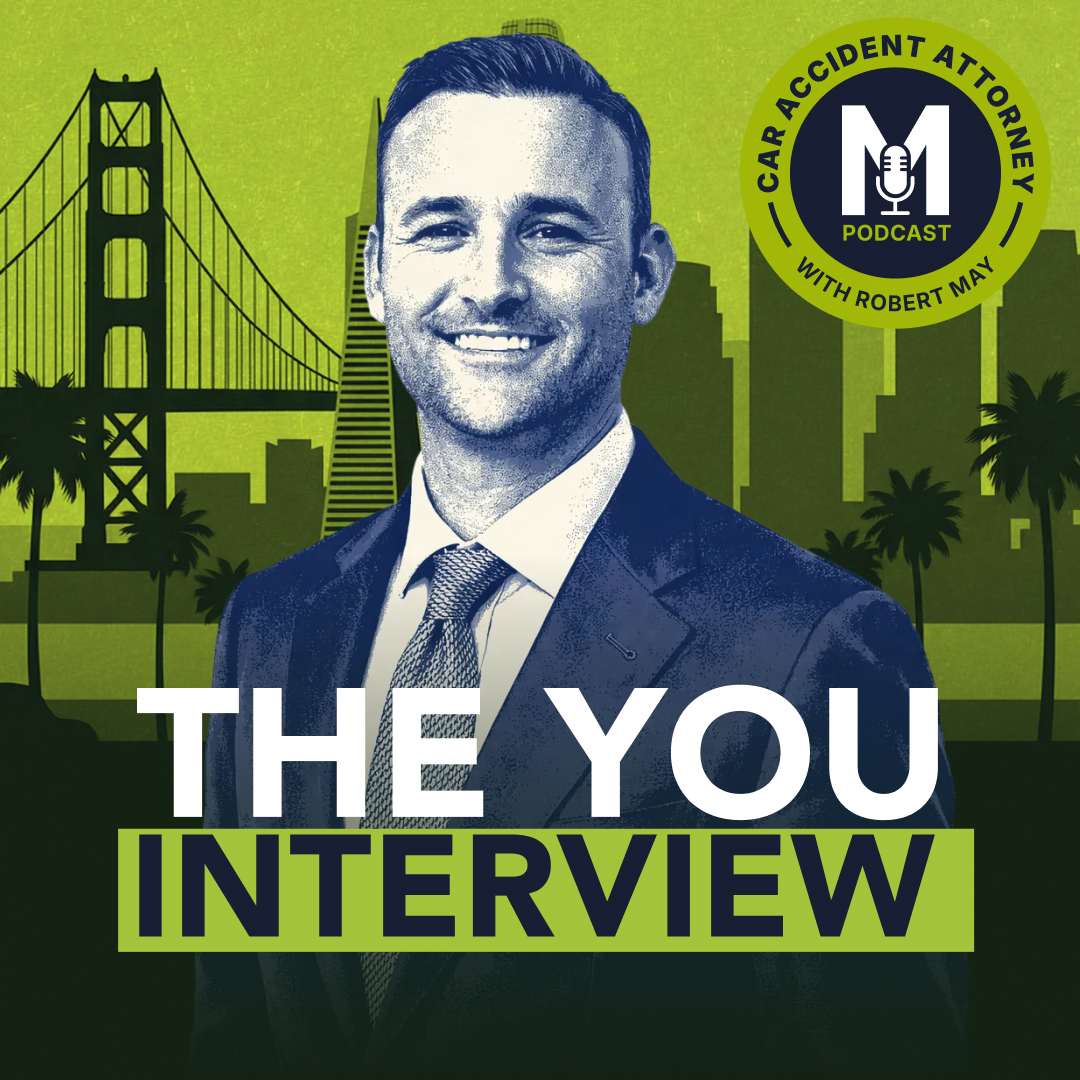
Before you hire a personal injury lawyer, you should know who they really are. In this debut episode, founding attorney Robert May sits down for an unfiltered, story-driven conversation about his life, his law career, and the values that drive everything he does. Robert opens up about the teenage injury that led him to California Western School of Law, his philosophy on negotiation versus trial, how AI is reshaping personal injury law, and how to reach The May Firm if you think you have a case.
The YOU Interview with Robert May
Real Answers for California Accident Victims
Car Accident Attorney with Robert May is the podcast Robert created to bridge the gap between the personal injury system and the real people trying to navigate it after a serious crash. Drawing on more than $450 million recovered for clients, Robert tackles the questions accident victims are most often afraid to ask, what a personal injury attorney actually does, when to call one, how to handle insurance companies, and what your case is really worth.
Each conversation goes beyond surface-level legal advice. Robert walks through the strategy he uses on real cases, from early investigation through negotiation and, when necessary, trial, and shares how the firm decides when to settle versus fight. The podcast also looks ahead at how technology and AI are reshaping personal injury law and what that means for clients and the attorneys who represent them.
Every accident victim deserves to understand their legal rights and options. This podcast is about empowering people with the knowledge they need during one of the most challenging times in their lives.
— Robert May
Episode Transcript
[00:00:00] Kara Sciarabba: Welcome to our very first episode. I'm Cara and we couldn't think of a better way to kick things off than with the you interview. Choosing a personal injury attorney can feel overwhelming. If you've ever been in an accident, you know exactly what it feels like. Suddenly you're surrounded by billboards, commercials, Google ads, all promising the same thing. Everyone's saying that they'll fight for you. Everyone's saying that they're the best. But when it comes to dealing with something this person all like your health, your family, and your future, the real question becomes, who's behind those promises? That's what this episode is about. Not the slogans, not the marketing, but the human behind the law firm. Today we're sitting down with Robert May, the founder of the May firm out of the state of California, to pull back the curtain and get to know the person behind the practice. We're talking about where he came from, what shaped him, and why he chose to dedicate his career to personal injury law. And Robert's story starts here. Robert, thanks so much for joining us today.
[00:01:11] Robert May: Cara, thank you for inviting me. Yes, absolutely. So
[00:01:11] Kara Sciarabba: let's just start at the beginning and take us back before the May firm, before the cases, what first put law school on your radar?
[00:01:25] Robert May: Unconsciously, I think what put law school on the radar for me was about the time I was 13 or 14, I got caught up in a non-criminal, but a bad situation where I ended up having my own personal injury lawyer and going through the court system, depositions, going to court, going to trial. And I remember during that time, one of the only people in my life that provided any sense of comfort or made me feel a little bit less, a less alone in the process was the attorney. And the underlying situation was such that kind of once it was over, all I wanted to do is move on from it. And I always wanted to quote unquote be successful work hard, figure out a way to go to college, et cetera. But that was that was deep down in my brain and years later after I had finished my undergrad in finance, I was deciding what was next, I had started to work on Wall Street, I knew that wasn't for me. I made a great friend who ended up being a mentor and a partner and he had just become a personal injury lawyer, he was telling me about it. And I remember that morning sort of having almost like a flashback and going, okay, this is what I'm going to do. I took the outset within a couple months and then went straight into law school and got done in two years, because I was so excited to have a plan honestly. And I never look back and it's been the best decision I've ever made.
[00:03:14] Kara Sciarabba: I love that. Everything aligns for a reason. And I know you grew up in the central coast of California and you were the first in your family to go to college. So what did that journey look like for you and did your perception of what it meant to, I guess, quote unquote, make it change it all during that time.
[00:03:34] Robert May: What making it has looked like from my 20s, 30s and 40s has been nothing but an evolution, but at that time, I would, if I'm being upfront, I was so driven by a little bit of a sense of fear of not making it. That I was so focused on getting from point A to point B and sort of getting all those classic markers of success. But yeah, I was, it was an intense drive. Yeah, absolutely. My 20s was a psychotic drive.
[00:04:13] Kara Sciarabba: Yes, I feel like a lot of us go through that journey in our 20s, definitely. And then you attended California Western School of Law with a strong belief in justice at this stage, what drew you specifically towards representing injured people.
[00:04:32] Robert May: I grew up with no attorneys around me, other than the experience I talked about earlier and my friend. And so personally, the only experience I had was in the personal injury space. And secondarily, my only mentor was in the personal injury space. So it was the only thing that made sense to me. I knew I'd never be a divorce lawyer. I knew I'd never be a tax attorney. I knew I certainly wouldn't be doing contracts all day. None of those had any correlation with sort of what my ethos was and the things I was interested in. So I never, I've never even thought about doing anything else.
[00:05:14] Kara Sciarabba: Yeah, absolutely. It's important to follow your heart. And you've built this career right here in California. So how has that experience shaped you the way you approach cases and advocate for people you represent.
[00:05:30] Robert May: So the main firm, as it's comprised almost is a reflection of sort of where I've been. We started in San Luis Obespo. It's opened almost immediately in the Central Valley in Fresno, where I lived for years and years. And then obviously we have offices in Southern California, San Diego, where I lived for 10 more years, went to law school. And so in many ways, all the different office locations sort of reflect different parts of where I've been as an adult. And so that sort of relationship to those geographies is kind of personal. I've lived in all those places. I know those places have relationships there. And so that sort of foundationally would explain kind of how we practice and where.
[00:06:21] Kara Sciarabba: Absolutely. And community is so important. So when you go back to your roots and you give back to that community, it's, it's super important to the people there and also you. So that's amazing. And then before we move on, what's one misconception about personal injury attorney that you wish more people understood?
[00:06:42] Robert May: I think what I would say is I wish people understood how much the good ones really care and think about this all day long. We were sending, I was sending a message at 10 o'clock last night for a client. It starts in the morning with clients. I think I wish people knew that there's so many really great lawyers out there. They truly care about these things from son up to sundown. And they think about it all the time they're trying to find ways to get better.
[00:07:13] Kara Sciarabba: Absolutely. And that human engagement to and just looking at a case or a situation from their point of view, I think a super important and to be able to understand that and kind of put yourself in their shoes. And that just helps get the job done at the end of the day, which is amazing. So. So let's talk about client experience here when someone has just been injured and they might be calling a lawyer for the first time. What's the first impression you want them to have when they contact the mayor?
[00:07:50] Robert May: I would think about it like this. If you ever bought an iPad or an iPhone, when you get it, sort of one of the things that separates Apple from other organizations is the packaging is very specific. It's very consistent. It's very quality. And it's very unique to the Apple brand. I kind of think of the client experience as being the very I want something very similar in the legal space, meaning all our own products to go to our client. I want them to access to us 24 or seven. I want multiple people assigned to every case immediately. So there's no chance. Once you become a client that there's any vacuum, there's any space where anything can be missed. And I am always just talking about what the most I want a frictionless experience for the client from phone call to becoming a client to having expectations to knowing step by step by step where they are in the process. And it's answered educational materials, everything I can think of and we can think of available to the client and I want to look nice to
[00:08:53] Kara Sciarabba: absolutely a well oiled machine. It sounds like where the client has communication throughout the whole process and Europe front with them about everything. And I think that's so important from a client perspective as well for them to be in the know. So that's amazing.
[00:09:24] Robert May: Oh, I'm sorry. Well, we did as we created an entire department at the law firm called client success. And that serves to ensure that each hand off if there is one is seamless. It's also a backup. It's almost like the new client success team checks in on every new client. Make sure they're having the experience they want. So there's even the smallest detail that they're unsure of or they had an experience that they didn't like something. It's remedied immediately because once we have a client, we want them to not only be our client throughout the duration of the case, but that's our. That's the way we grow the law practices through those relationships. And so we have an entire department. Just meant to have each client have the best possible situation and experience in a really tough experience at the same time.
[00:10:22] Kara Sciarabba: Yeah, no, that's great. And then a lot of people worry that their case will drag on forever. So how do you help clients understand whether their case is likely to settle or kind of go the distance.
[00:10:37] Robert May: Sure. So we keep very we have data on different case types, geographies, etc. So we have estimates, but a lot of that is expectation based. So if the client understands the process and what that means. Just for understanding of the time it takes to do the right job. You took your card on mechanic and they said they could get it done a big job in two days. You're just not going to get it. The job's not going to be done correctly. But if they explained each and every step of the that they were taking, this is why we sand it down. This is why we had primer. This is why we check the paint. This is why we have somebody else that does this. It's going to it might take a little longer than you hoped at the beginning. But when people understand what's happening. They they know what to expect and it's really unmet expectations that causes that disappointment.
[00:11:33] Kara Sciarabba: Yeah, absolutely. And then that actually leads me into something I'm curious about when it comes to your work, how do you personally define success? Is it the result? Is it the process or something deeper than that?
[00:11:44] Robert May: I think it's something deeper. We're obsessed with process at the May from to make it the best experience possible. But us having a great process alone doesn't mean the clients getting the best result. We're we're constantly monitoring results of cases relative to potential outcomes. But the bad I mark success is the most efficient frictionless best result possible. So everything has to come together for me to consider that a successful outcome for the client. We get a policy limit. But if it takes you three years to get a policy that you should have gotten a year. I don't think of that as a successful outcome for the client.
[00:12:36] Kara Sciarabba: Absolutely. No, that's great. And then your motto is to treat clients like family. So what's something about you or your firm in the way you operate that tends to? I guess surprise clients and set you apart from other firms in the area.
[00:12:54] Robert May: I mean, the basis of the motto is that the firm was started with myself and my two brothers, Garrett and Cameron. And so the foundation of the firm is literally three brothers starting a law practice, a business and an organization together. And as a result, I think that really was the foundation of it. It wasn't one person in charge. It's not it's not a dictatorship at the firm, meaning if you have siblings or brothers usually know there's a lot of give and take back and forth. And so each one of us sort of holds the other one accountable and has a result. It becomes much easier to stay true to sort of where the firms started and what the foundational beliefs were as it's grown over time because we're still together. We're all holding each other accountable and sort of want to have that initial ethos and experience. We've tried to make it just better and better as it's gotten bigger. And the way it is today is it's just much better than it was 10 years ago. And in two years it's going to be better than it was today because it's really constant refinement because you know, even if you're in a family. A family doesn't take care of itself by just being a family. It takes care of it by working on it and paying attention everybody where they're at. And sort of that's that's I think the underlying aspect of the families that it's growing together and it's a group that cares for one another. And that extends to each team member and then it keeps going to every client. Everybody would work with other attorneys, how we treat people. So it started from something sort of small and maybe easier to manage and now it's it just keeps growing.
[00:14:49] Kara Sciarabba: Yes, absolutely for the best. So you've represented thousands of personal injury clients, often again, some of the largest insurance companies in the country. So walk us through how those early years shape the attorney that you are today.
[00:15:06] Robert May: Sure, I was really lucky as a young lawyer to have exposure to what you call big cases, significant cases against Toyota PG&E. And frankly, I didn't know what I was doing. I knew what I knew the outcome I wanted. And then I would just reverse engineer by reading every Toyota case, looking at samples of what everyone else has had done and kind of took that same. It was a little I mean, it was the fear of being in my 20s and sort of I'd reach just one point now I'm a lawyer, but now I don't just want to be a lawyer. I want to be a lawyer that has the kind of success I had in my dreams. And so I need to do that it would just it would just take that kind of obsession. And so that's all I did and you know was able to achieve really pretty great results relative to the amount of years I had in the practice. I just I've just always taken that same mindset into every phase of running a lot firm, you know, I'm interested in so I just have a lot of things I like to learn about and I'm interested in and I try to take things I learned from other businesses, aspects, life, etc. I bring those into the practice.
[00:16:31] Kara Sciarabba: Yeah, absolutely. And then without getting into any private details, is there a case or a moment that really stuck with you over the years.
[00:16:41] Robert May: In my case is a really stick or the ones we have a ongoing relationship with the client down the road, you've seen him get married, you've gone to their wedding, baby showers, you might see them in town and they're now sort of maybe gone from being a young adult to an adult and a professional and you see this evolution in their life and that's like incredibly meaningful to me. The losses that are stuck with me in a way that are like won't leave. And it's not regret in the form of what was done. It's just, you know, jury trials are hard and federal jury trials are even harder and they just still live in my brain and my heart and you just wish you had a different outcome. And then some of them are not the biggest cases that really live with you. It's, it's the impact and it's sort of how much these cases mean to them personally that, you know, if you have a client that's in tears with gratitude, it's like that's unbelievably, it feels incredible. And those are the things you really try to take in as much as you can because that's a really, it's a really hard job and those moments are special and kind of stick with me. So they really all come together. There's just so many different pieces that shape you over time and inspire you and break your heart at the same time.
[00:18:25] Kara Sciarabba: Yeah, absolutely. I feel like that emotional connection that you take with these clients that you take on. I mean, it's so great to hear and see how much it affects you and how much it humbled you and also how much it shapes you to be the attorney you are today. So Robert, you've secured more than 250 million and verdicts and settlement. So when you look back on your career, what moments remind you of why you chose this path in the first place?
[00:18:57] Robert May: Can I rarely look back? I'm really honestly just looking forward to kind of what's next. Sometimes when I look back, I look back on things I could have done and should have done better. And so those are constantly shaping, whether it's how the firm operates or my skills as an attorney and where I need to get better. I'm always looking that way. I'm just honestly really just think about what I'm doing now and what I can do down the road more than ever really look back.
[00:19:36] Kara Sciarabba: Absolutely. And what the future holds for the May firm and you as an individual and then be on the individual cases, you've built a firm around personalized attention. So what drives you to focus. So I guess intentionally on the human side of this work.
[00:19:55] Robert May: I'm always thinking about what the client experiences and a client experience is individual. It's theirs. And so I'm just putting myself in their position. I can do it personally. I've been in a personal injury client. I've had injuries, I've had surgeries, I've concussions, like I kind of been the client and have been the patient. And so I'm always thinking about what that experience is for myself and how it could have been better and then trying to find ways and processes within the law firm that can give the client that experience I would want. And I also take advice from staff, other attorneys that are that I think are doing great things and take pieces of those and implement them. But it client doesn't care if you have five cases or 500 cases of client understandably and should only care about their case. So I'm thinking about it from one person's vantage point in that regard. Like what's that clients experience. And if you make that clients experience the best it can be. You just multiply that across every client. That's what you're trying to accomplish.
[00:21:21] Kara Sciarabba: Yeah, absolutely. And then for someone hearing about the May firm for the first time, I guess this goes into how would you describe the firm and the difference you're trying to make in people's lives through the cases that you take on.
[00:21:37] Robert May: I think most people in a legal space would know the law firm as these are good people. Honestly. For the client, I want them to know the same thing. You've hired a great firm. Every law firm in the world says they're super aggressive and super this and super that. Okay, what does that mean though for if you're a client, you're super you mean are you abrasive what like what does that mean for a client. So I'm really trying to focus on being true to who we are. If I just said we're super aggressive. Okay. We're pretty nice, honestly. And that's what I want the law firm to be being nice and being very good at what you're doing are two different things. So you can have a good bedside manner and be a great surgeon. Absolutely. You don't have to be awful to someone to show you're good at something.
[00:22:41] Kara Sciarabba: Absolutely. And that's why your motto is treat everyone like family. So I love that. So let's zoom out for a moment. What's the bigger mission behind the May firm and what are you ultimately trying to build?
[00:22:58] Robert May: Trying to build a law firm that values human connection, even as technology pushes the practice further and further forward.
[00:23:08] Kara Sciarabba: So
[00:23:08] Robert May: the way to differentiate yourself in the future is actually going to be how deep the connections are you have with your clients. We utilize technology like any other law firm, probably more than most law firms. So we're determined as safeguards secondary, you know, a secondary way to look at large levels of information, but I think to differentiate yourself in the future you're really going to have to be more focused action on the person.
[00:23:43] Kara Sciarabba: Absolutely. And then the legal landscape is consistently evolving and we know this, but how do you stay sharp and make sure the firm continues to serve your clients at a high level like that.
[00:23:56] Robert May: I think you stay sharp by really loving what you do. And so, you know, I love this job. I love this law firm. And so as a result, I'm always looking around to see what other lawyers are doing other law firms are doing what other industries are doing to create better experiences. We try to take things from everything I'm taking in and then kind of filter out what I what I really love what I think is really great. And then see if we can bring that to the law firm and provide a different experience, maybe then another law firm might.
[00:24:37] Kara Sciarabba: And we know technology has changed the way a lot of businesses communicate, but how have you used that inside of the may firm and using it as a way to support your clients as well.
[00:24:51] Robert May: There are so many different AI services available that people are purchasing, subscribing, whatever you want to call it and kind of trying to bolt on. That's what I would call it to their law practice. We've reviewed most of those and our solution is to build everything in house. I want an integrated solution for our clients. I want to build a manage each piece of technology we're using and make sure it's. Follow sort of our ethos and our strategy and what we want to client experience to be when you take outside software however you want to describe it and put it on your law practice. You're really taking a piece of technology that's aimed at the average. It's aimed to work across all law firms while law firms different. So when we create technology, I want to be in charge of each and every decision that's made within that technology, so it matches to what we do. I don't want a piece of technology you can put on each and every law firm in California.
[00:26:07] Kara Sciarabba: Absolutely. It's not a copy and paste. It's more unique to the individual firm and that sounds like what you guys are doing there and then kind of looking ahead, where do you see personal injury law heading in the next few years because of this.
[00:26:24] Robert May: I think you're going to see what you've seen, which is big investment by hedge funds. I think you're going to see firms that don't have their own process. Hold on all these different applications. It's going to become boring versus having something that's really good and great for the client experience. I think it's going to become sort of ubiquitous. There's going to be people that have really unique niche skill sets, great, great trial lawyers that are going to have a space. And I think there's going to be law practices that have created great processes that are specific to their brand to their firm to what they believe they're going to have you able to provide great services to their client. And I think you're going to see a lot of really average work. If you're looking around the legal landscape, the word scale is used a lot and how do you grow at scale, meaning how do I grow the size of this law firm and have enough things put in process to where I can, quote, handle it. I think scale is fine. But what people aren't saying is like, how do you do a great job at scale? How do you make it personal at scale? That's a totally different skill set. And that's where my law firm is focused is as you grow, how do you provide the same level of personal service while utilizing all the technologies that can be used to backstop things like, you know, a missed word and a medical record, a witness, something that could be lost. You still have that safeguard behind it, but I don't hear people talking about the client. I think I hear him talking about sort of how do you save money, get more clients. It's just more like revenue efficiency. It's not client focused. And I think those firms are going to they'll fall apart and they'll have clients that are upset and call other law firms that are doing a great job.
[00:28:32] Kara Sciarabba: Absolutely. That personal touch is so important. And then when you are faced with a tough decision on a case, what principles guide you to choose the right path or what's kind of like your north star when it comes to those cases?
[00:28:48] Robert May: Two things. It's one, you just have to be really honest with the client. And then secondarily, you know, if you if you start your law firm and it's it is a very competitive business, there's some part of you that's going to be a little bit of a risk taker. And so I'm still a little bit of a risk taker. There are cases where sometimes people go, I don't know. I don't see it. And sometimes you won't see things. If you're just looking for again, if you're going back to the average and looking to take a few boxes and then you'll sign that case. And if it doesn't click every one of those boxes, we just say no. I really try to look creatively at cases because there's so many times somebody might say, I don't know about this case. And then I'm like, no, there's something there, we just, you know, you can't just scan it and discard it. That's something that's like a little bit of a foundation. I do like to take risks.
[00:29:49] Kara Sciarabba: Yeah, absolutely. And then on a personal level after everything that you've accomplished, what still motivates you to keep you doing the work you do day after day.
[00:30:02] Robert May: That's just who I am. I just I don't know. I'm obsessed with things. I have other things I really like. I'm obsessed with those things too. For do something, I want to be good at it. I want to know the most like possibly can about it. And, you know, as they get older, I think it's a little different. You're 20, you're obsessed with yourself. You get older and older, you have more kids, you have bigger kids, you know, you're trying to show them like this is what it looks like to work hard. This is what it looks like to work hard and manage life at the same time, you know, trying to in some way set an example for them. Not just in terms of success, but really in terms of this is what working hard looks like.
[00:30:53] Kara Sciarabba: In doing the right thing and helping people out at the end of the day and that that's a great vision to have especially for your family to see. So for someone listening who thinks that they might need help, Robert explain to us what's the best way they can reach you and your team.
[00:31:10] Robert May: It's pretty easy to get in contact with this and you can call text, email, obviously on the internet, social media, it's pretty easy to find a lawyer these days finding a right one. That's a that's a different question, but we're pretty easy to find.
[00:31:30] Kara Sciarabba: Absolutely. And then once they reach out, what happens next kind of walk me through that first conversation that they'll have with you.
[00:31:36] Robert May: Sure. So depending on how we're contacted, assuming it's not via phone call, a member of our team will call you immediately respond to your text in the event you send us a message, you'll get a response immediately. A phone call immediately. And then from there, you know, you really start sharing your story and then we can share the story of who we are and see if it's a good match. And then if so, you're going to get everything we have. We're going to do our best for you.
[00:32:06] Kara Sciarabba: Absolutely. And then is that consultation free and do you offer any virtual options for people who may not be able to come into the office?
[00:32:16] Robert May: Yes, absolutely. The consultation is most certainly free. We do have virtual options for clients, of course. We also have nine offices currently in California that are real offices with real people, real team members, real lawyers, so you can come in, of course, and we're happy to meet clients in the office. And then often we'll travel to clients in their home or wherever they wherever we can meet them that's safe for them. We do that as well, of course.
[00:32:44] Kara Sciarabba: Convenience is key. And then what would you say to someone who's unsure whether they even have a case or not?
[00:32:52] Robert May: Sure. Don't hesitate. Don't delay. Contact somebody right away. A lot of times people will contact us about cases that might not be we might not be the best fit for. But having relationships over 20 years in the space, I know who I would contact if I was in their position until a lot of times we're even helping people find the right attorney for them.
[00:33:16] Kara Sciarabba: As we wrap up today, there's a lot to take away from your story, Robert, not just about building a successful law firm, but about showing up and sticking with it and treating people like people when they're going through some really tough moments. So we talked about how overwhelming life can feel after an injury and how much it helps to have someone in your corner who actually listens, explains what's going on and really truly cares at the end of the day. This isn't just a case. It's about the person behind it. So Robert, before we go, I want to give you the chance to leave our listeners with just one final thought.
[00:33:54] Robert May: Well, thank you, Cara. It was nice talking to you today. The final thought is it's it's a great honor to be a to be an attorney to be a personal injury lawyer. I don't take it for granted. I think about clients every day and it's I just can't think of a better job in the world to have and it affords me the opportunity to meet so many amazing people to work with great people to learn. And, you know, it's provided me with the life that was sort of the dreams I had when I was in my 20s and scared and worried about getting into school, graduated from school, being able to provide for my family, all those things. It's given me all that. And so I try to keep working and do the best I can to, you know, honor what it's given me.
[00:34:46] Kara Sciarabba: If you or someone you love has been injured in your unsure where to turn, Robert and his team at the May firm are there to help guide you through the process, even if you're just looking for clarity or next steps. You can learn more and get in touch by visiting mayfirm.com or giving them a call at 844 May firm. That's mayfirm.com or give them a call at 844 M-A-Y-F-I-R-M. No pressure, just straightforward guidance from people who treat you like family. Thanks for spending time with us today and remember when it comes to choosing a personal injury attorney, trust matters and the right team can make all the difference. We'll see you next time.
Other Episodes
Subscribe to the Car Accident Attorney podcast to stay informed about your legal rights as a California driver. Robert May shares valuable insights, answers common questions, and provides practical guidance that could make all the difference if you're ever involved in an accident. New episodes deliver the legal knowledge you need to protect yourself and your family on the road.
Frequently Asked Questions
Common questions about the podcast, personal injury law, and working with an attorney.